January 6, 2018

Mars Prison Station

Mars Prison Station is now ready to house 6 of the systems most dangerous space criminals.  These are criminals who have committed crimes in space so horrible that no nation on the planet wants to let them land on their soil.

The Mars Prison Station takes high security to the extreme.  Unlike other stations, there are no vehicles on standby at the station. There is only one docking port and it is protected by docking bay doors.  Vehicles transferring supplies and personnel must follow strict procedures for docking with the station.

The outer bay doors remain closed until the incoming ship has been verified and all prisoner secured.  Then the doors are opened and the vehicle is allowed to dock, but the hatch is left closed.  The outer bay doors must be sealed before the hatch is opened.  Vehicles only remain docked for a few hours at a time while the transfer takes place. Once the transfer is complete, the hatch is sealed and a bed count is performed to make sure all prisoners are still secure.  Only after all the prisoners are accounted for are the outer bay doors are opened and the vehicle is allowed to depart.


The first prisoner scheduled to be to sent to the Mars Prison Station is Sergie 'Decompression' Tremp.  His nickname comes from his preferred method of murder by exposing his victims to the vacuum of space.

He was serving aboard the Toledo, a cargo ship in deep space.  He murdered the other 3 crew members by luring them into the air lock and then decompressing the airlock before they had a chance to put on their space suits.  After running out of victims on his own ship, he triggered the distress beacon.

Another cargo ship, the Loshad, was nearby.  When it arrived to help, he waited until it had docked and had opened the hatch to board.  Segie laid in wait in his space suit while the Loshad came to assist.  When a member of the Loshad crew was boarding the Toledo, Sergie, opened the other exterior hatches on the Toledo.  This immediately killed two of the crew members.  The other two crew members were able to seal off the hatch to the Toledo before all of the atmosphere escaped.

Sergie then killed one of the remaining crew members of the Loshad after she re-boarded the Toledo in a space suit to investigate what was presumed to be an accident.  Sergie slit open her space suit with a large utility knife.  At this point the last remaining crew member of the Loshad sent out his own distress call that also warned about the serial killer on the loose on the Toledo.

Sergie was found trying to drill a hole in the Loshad's hull when help arrived.    He managed to kill another three people during the struggle to capture and transport him back to the inner solar system.

January 3, 2018

Planetary Resupply Advances

Centauri Spaceworks has made advances in resuppply the planetary bases on BLU and PUR.  Previously these bases were supplied with with a cargo bay on LK Lander Legs.  After the  tanks and batteries were empty, they were  discarded.  Launching the supplies back to orbit to be recharged was cost prohibitive since the LK Core and LM Ascent stage can only hold three cargo.  This uses fuel and leaves the discarded lander legs on the surface.

The new approach documented below allows the expended tanks and batteries to be retrieved from the surface and recharged in an orbital station.  The resupply does take several minutes to complete, however it only uses a small amount of fuel, and does not require a launch of supplies from HOM.  This makes it much more environmentally friendly and cost effective.

For this proof of concept effort, Centauri Spaceworks launched a very small station consisting of an oxygen garden and an ATV.  The station was located in geosynchronous orbit above the base on BLU.  It was just above orbital velocity.  Below is the procedure for the cargo transfer and recharge.


Step 1: Pre-separation
  • Secure cargo
  • Close hatch
  • Check that fuel switch is closed
Note:  If your station is relying on the ATV for power, at least one battery needs to remain in the ATV to power the station.

Step 2: Separation
  • Undock
  • Check velocity to insure it is still above orbital velocity
  • Add velocity with thruster burn if required
The transfer won't work if the ATV is docked to something else.  The separation will  push the ATV into a lower orbit above the tops of the ground modules. If the station is set up at the correct altitude this will position the ATV for the transfer without using any fuel.


Step 3: Transfer Cargo
  • Switch to cargo mode and prepare for transfer
  • Transfer cargo
  • Switch back to fly mode to prepare for re-docking
When the ATV passes overhead of the modules, you can transfer cargo between them.  This has a limited range so the ATV has to be in a low orbit and nearly overhead to the ground modules.  At this point the ATV will be moving faster than the ground modules so there is a limited time to transfer cargo.  It may take several orbits around to transfer all the cargo between the surface and the ATV.


Step 4:  Re-dock

This part requires some piloting skill.  You will need to use the main engines on the ATV to boost it to a higher orbit.   Despite the ATV and station having similar velocities, this is not a straight dock.  They have different ground speeds because of the difference in altitude.  The station makes a bigger circle so it takes a longer time to make a complete orbit  compared to the ATV.  You will need to time the ATV's burn so that it reaches the station altitude at the same moment the ATV passes beneath the station.

Step 5: Recharge
  • Connect ATV and oxygen garden power
  • Recharge tanks in the oxygen garden
  • Recharge batteries in the ATV

January 1, 2018

Centauri Allows Reuse of Designs

Did you know you can use and adapt all of the ships and vehicle designs by Centauri Spaceworks?

So many other people and agencies have inspired the designs that are published by Centauri Spaceworks.  I hope that I can give back to and inspire others with my designs.  I don't want anyone to feel like they cannot copy or remix designs from Centauri Spaceworks.

The ship and vehicle designs are licences under the Creative Commons Attribution 4.0 International License.  This means you can use, adapt and share the designs you see here as long as you give appropriate credit to Centauri Spaceworks when posting. That is a simple as stating that the original design was by Centauri Spaceworks. If possible, a link to the blog is appreciated.

This is intended to encourage reuse and remixing.  It is not intended to make it more difficult by requiring a list of credits for each combination of parts.  The requirement for credit only applies to entire vehicles or stations.  If you reuse a feature of a Centauri vehicle or station, no credit is required.  Although it always appreciated.

December 30, 2017

High Security Station

I am pleased to announce that Centauri Spacework's latest, station, the High Security Station, is now operational.   This general purpose station offers enhanced security and reliable power.  It is the largest station constructed by Centauri Spaceworks to date.  It has a total of 118 modules.


To supply the power needed for the 4 oxygen gardens, medical bay, and other modules, the station relies on six nuclear reactors modules, two large solar panels. and a ring of smaller sensor module solar panels.  The decreased reliance on solar panel means the station no longer has to maintain a large array of panels, which are susceptible to dust and collisions.

ATV secured in a docking bay
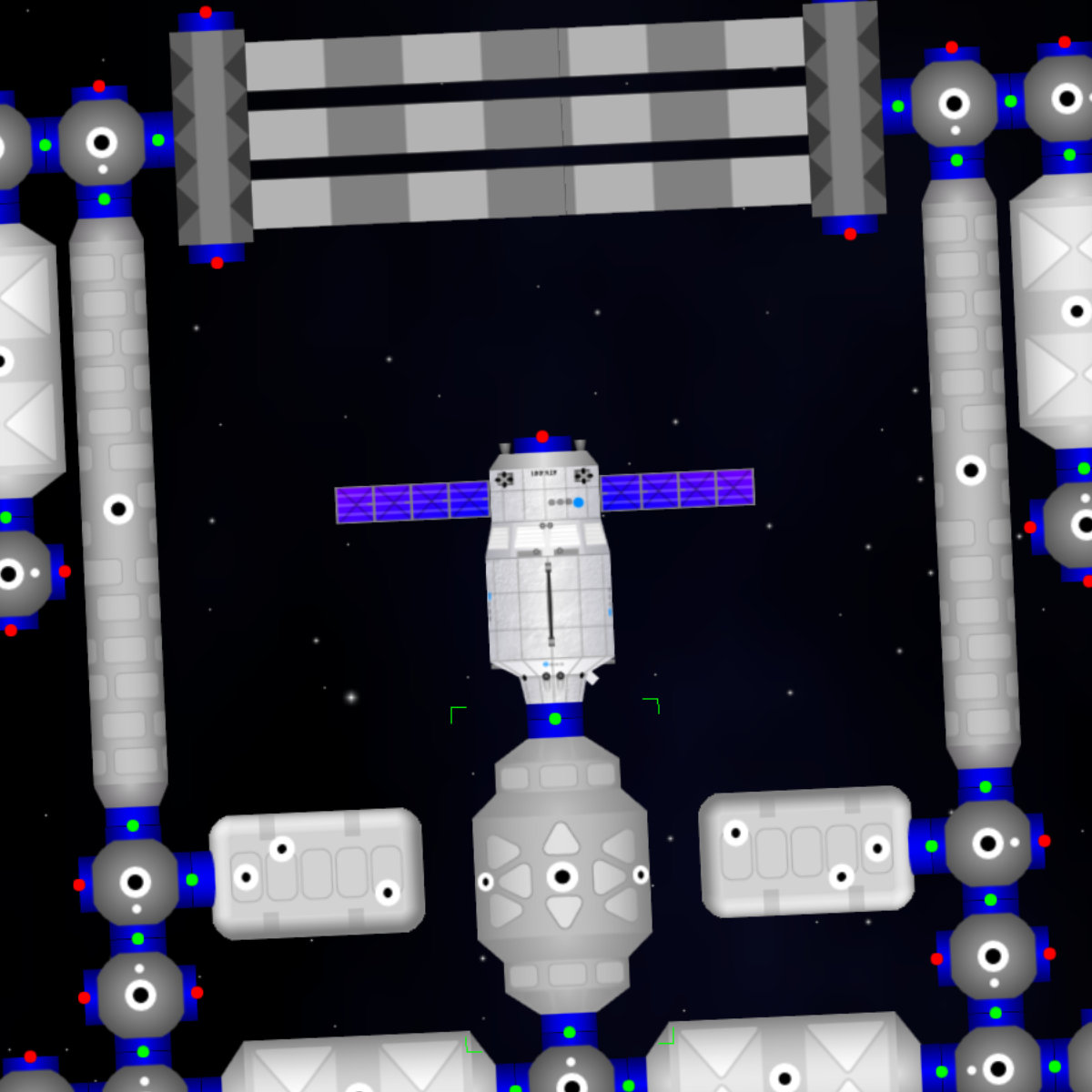
The station is named for its three high security docking bays. These bays feature an airlock for atmosphere isolation.  The radiator doors to protect the docking bay port and any ship docked there from space debris, solar radiation, or prying eyes.  Due to the limited size, only smalls vehicles such as an Orion or an ATV can be docked. Larger vehicles will need to use a shuttle to move cargo and personnel between the HSS and the vehicle.

Next up in the schedule of Centauri Spaceworks line of enhanced security stations will be a prison station.

December 29, 2017

Proofreader Hired, Corrects Name

Today, Centauri Spaceworks hired their first proofreader, Jonathan Bean.  Jonathan promptly found that Centauri Spaceworks' name had been misspelled in many places. Numerous places had omitted the 'u', labeling the organization as Centari Spaceworks.

Given the wide spread nature of the misspelling, the board of directors considered simply changing the official name to Centari Spaceworks and leaving the misspelling.  However, this weakened the connection to the stars which the space agency was named after.  The board voted by 9-1 to begin the slow process of correcting the name to the correct spelling of Centauri.

In the next week the website will change from centarispaceworks.blogspot.com to centaurispaceworks.blogspot.com.  Blog posts will be updated with the correct spelling.  Rockets will be re-painted. Signs will be re-signed.

From this day forward Centari Spaceworks will be known by its correctly spelled name, Centauri Spaceworks.


December 22, 2017

Sci-Fi Ship Design Contest


I have done over forty posts about the ships  I have made.  I like sharing my ships, but I also like seeing the ships others make.  I like being inspired by their creativity and designs.  So I decided to try something a little different.  I want to issue a challenge to all the space agencies out there.  A chance to show off your creativity.

The Challenge: Design a ship or station in Space Agency that is inspired by a fictional ship or station.

And to sweeten the deal, the best ship gets a big trophy.  You can post it on your profile or social media. You can even frame it and hang it up.


To enter, email the following information to centaurispaceworks@gmail.com :
  1. Screenshot(s) or sandbox of your ship
  2. Sci-fi ship it is based on
  3. Your name, your agency's name, or however you want to be credited
  4. (Optional) A link to your social media, wiki profile, or website.
The entries due by January 19th, at midnight.  One entry per person.  I'll post all the entries to my blog and announce a winner after the contest closes.

Thanks to zombie8259 for giving me the idea for the theme of this contest.  I'm looking forward to seeing lots of great ships.

Update:  The contest has finished and you can see the results.

December 19, 2017

Construction Update

The new, yet un-named, station is getting closer to commissioning.  All three docking bays have been completed.  The majority of the interior modules have been placed.

The power section is the only major section of the station still under construction.  After several different designs incorporating the CSgt Nuclear Generator were explored, one has been identified that should be able to fully power the station.  The station is currently using two ATVs with batteries in the docking bays to keep it powered while under construction.

In the image below you can see a fresh shift of astronauts in a new Draco Crew Capsule passing through the docking bay doors of a recently completed docking bay.  Docking in the high security docking bay requires a steady hand due to the close clearances.


In the past week the stations become the largest object constructed by Centauri Spaceworks at 108 modules.  The total module count at completion is expected to be closer to 120.

December 15, 2017

1.8 Update Review

The 1.8 update just came out and it is a strong update.  It has new missions and a lot of new parts.

The update adds missions 33 and 34.  Mission 33 has you installing a new CSgt Nuclear Reactor on the MSS.  Mission 34 is sending an ISAAC module and an Orion capsule to the ADS.  It was nice to have Mission 34 work in the chance to use the LP1 from the last update.


The CSgt Nuclear Reactor is a great addition that brings new functionality of permanent power source that isn't a solar panel. No longer do you need to keep stacking up solar panels to power your station (or using to the ATV battery hack).  The reactor generates 200 power, and consumes 6 for a net production of 196.  That is almost double what you could get from a large solar panel and in less space.  It still isn't a small part. It requires an extra long fairing to launch because of the long truss that the reactor is attached to.    It would have been more flexible if it could be split into the tiny reactor and an extra long truss, but it is still a great new part for adding on to stations.

The ISAAC module is basically a round habitation module.  It has one docking port and holds 4 cargo.  The round shape is a nice variation compared to the other mostly rectangular parts.

Both the ISAAC module and CSgt Nuclear Reactor were named after active members of the Space Agency Wiki. It is really great to see them honored like this for their contributions to the community.

The update also includes a plethora of new add on parts with the Nooleus X add-on.  It costs $5.49 USD.  It gets all the Draco and Eagle 8 parts needed to rival SpaceX.

  • Draco Crew Capsule
  • Draco Cargo Capsule
  • Draco Trunk Module
  • Draco Fairing
  • Eagle 8 Second Stage
  • Eagle 8 Connector
  • Eagle 8 Reusable First Stage
I love seeing the new parts.  This is a must get add-on for any SpaceX fans. 


The Eagle 8 is a more powerful version of the reusable LP1 rocket introduced in the last update.  It has the same mechanics.  If you successfully land the 1st stage after a launch you are awarded one quick launch.  Just like the LP1, the Eagle 8 feels a bit more like a balloon instead of rocket when landing.  If you keep the engine on for too long it starts gaining altitude.  You end up tapping the the thruster in short burst to bounce the rocket up and down and get it centered over the landing pad.

The Draco capsules are a nice alternative to the Orion capsule, but leave the Draco Trunk at home and use an Orion Service Module.  The Draco Trunk  has some bugs that limit is usefulness.  Even though it has main engine fuel, it doesn't let you fire main engines.  And if you do get to your destination on the thruster propellant, there is no way to get the cargo out of the trunk.  If those bugs get fixed it will be a great cargo hauler: eleven cargo in one launch!

This is a great update and I am hoping that Nooleus can continue putting out updates like this on a regular basis.

Draco Cargo Capsule + Draco Trunk.  The cargo is trapped in the trunk 

Update Dec 27, 2017 : Nooleus release the 1.8.1 update which included a fix to allow the Draco Crew Capsules' main engines to fire while it was attached to the Draco Trunk.  Unfortunately, it still is limited in its functionality without a way to get to the cargo stored in the trunk.

December 11, 2017

New Station Under Construction

Centauri Spaceworks has started construction on a new station.  At 78 modules, it currently rivals the 79 module Xerces station.  Once completed it will be the largest station constructed by Centauri Spaceworks.


This new station takes advantage of the newer cargo bay, corridor, and airlock modules.  It is on track to consume 800+ power.

One of the core features are the three high security docking bays.  They are protected by retractable docking bay doors.  Inside the high security docking bay, the ship to station connection is bridged by an airlock that can be used to isolate the docked ship from the station air supply.


December 4, 2017

Xerces Station Upgrade

The original Xerces Station

Xerces Station upgraded with corridors and an air lock.
The original Xerces Station gotten several upgrades in the past two months.

The biggest change is the replacement of the arms leading to the solar panel arrays.  Previously these arms were formed by two modules and a hub.  These three modules were replaced with a single corridor.  This helps conserve power, as the corridor only requires 5 power, in place of the 45 power used by three previous modules.

This upgrade reduced the clearance between the solar panels and the core of the station.  To compensate, modules were added to extend the core of the station past the solar panels and still allow spacecraft to utilize the docking ports at either end of the core.  Two Apollo CSMs are currently docked at one end of the core serving as life saving ships.  These will eventually be used to return crew members to HOM and replaced with newer Orion IIIs.

Other changes include an airlock module added on the HOM facing docking area to support EVAs and docking with ships that required atmospheric isolation.  A new med bay for medical emergencies was installed in place of one of the old control rooms.