Showing posts with label Stations. Show all posts

June 8, 2022

Spaceport Station

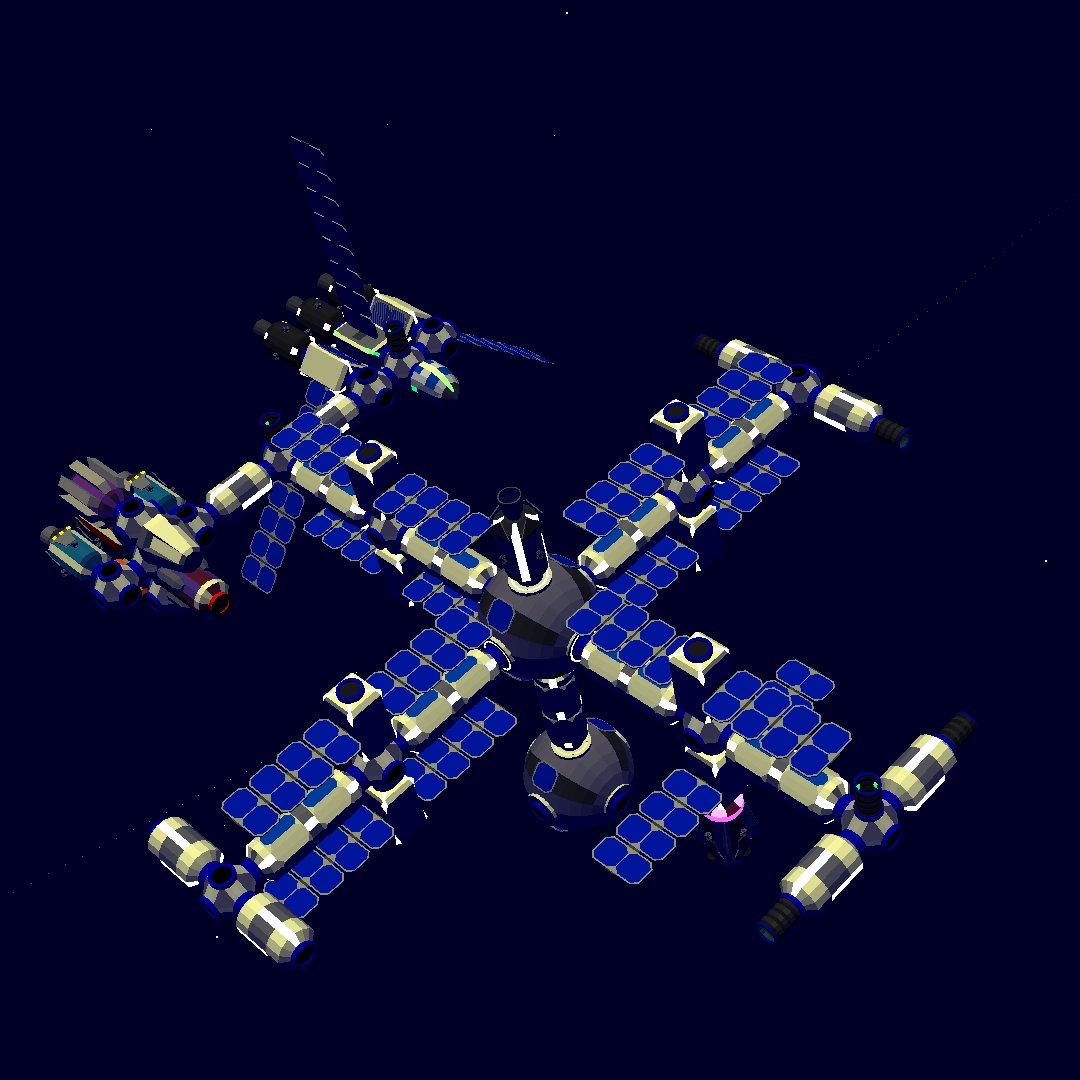
 The Spaceport Station is the main docking hub for large capital ships.  It has 8 docking ports around the large central hub.  A view dome at the top serves as the control center.

The first two ships to dock at Spaceport Station were the Genosis and Lambda Six.


They were joined by Oberon after it had finished helping to construct the jump gate network.  There is also work being done to expand to a second level.


May 21, 2022

Home One Station

 Home One is Centauri Spaceworks main station in the Space Agency 2138 universe.  It evolved from the original Station 38.


Home One features a large solar array at the top of the station.  Below it there is a hydroponics arm with two hydroponics modules and a moisture recovery unit.  There is also a communications arm with a satellite link to the ground. 

At the bottom of the station is the jump gate.  Home One is the center of a hub and spoke system that Centauri Spaceworks has constructed.  It connects all most all the planets to the home planet.  From here astronauts on the station can connect to any other jump gate in the system.


July 17, 2018

Trade Station Omega

First, an apology for no blogs last week.  Centauri Spaceworks has been diversifying into Tiny Space Program.  A significant portion of resources has also been devoted to developing an asteroid mining game.   And everyone in the Space Agency division decided to take their vacation last week.

Here is preliminary design of Trade Station Omega.  It isn't complete but it is close. The design doesn't have the locations of the oxygen gardens, med bays, and control rooms placed.  It also doesn't have the power calculations, but with 4 nuclear generators and 12 large solar panels it should be enough to power it.


It does have 4 major docking ports (the airlocks), 4 minor docking ports (modules at 90 degrees off off the air locks), and two high security docking ports.  That is a total of 10 docking ports for ships. 

What suggestions do you have for it?  Tweet @CentauriSpace.  Maybe your suggestions will make it into the final design.

May 24, 2018

Trade Station Gamma

The labor shortage at the workshop has gotten worse so this week there is another set of plans for you to build.  These plans are for a modest size space station to support interplanetary trade. The design is named Trade Station Gamma.  It functions as a small cargo port where ships can dock and resupply or transfer cargo.


With two main airlocks for ships to dock at this station is best suited for moderately traveled trade routes. There is a larger trade station design in the works that includes four main airlocks, two high security docking bays, and four auxiliary docking ports. The larger plan would be more suitable for heavy traffic trade routes near HOM.

Despite it's modest size, the station is fully equipped with facilities.  These include a control room, oxygen garden, and medical bay.  There is a long rang communication antenna as well as a cargo hold for temporary storing cargo awaiting transfer to another ship.

Safety features include an asteroid and meteorite detection system mounted on the upper left support wing.  An Orion III escape pod is also docked at the lower right support wing of the station.

Be sure to comment or tweet if you build this station or modify the design.  Looking forward to seeing your builds!

May 17, 2018

Station Icarus

After the destruction of Solar Outpost 1, and the subsequent abandonment of Solar Outpost 2, the need to do solar research increased.  A new station, Icarus, was constructed.

Station Icarus close up


Station Icarus is positioned in a similar location to Solar Outpost 1. However all parts of Icarus were kept outside of the circle of influence to avoid avoid falling inward if another gravitational fluctuation occurred.  If an experiment requires being inside the sphere of influence a probe can be launched instead of placing the station in the solar orbit.

The sun and station Icarus floating some distance away at waypoint ICS

Station Icarus has been in service for some time now.  An oversight in the public relations department delayed the publication of information about it until now.

April 30, 2018

ISAAC Star

Centauri Spaceworks started work on developing an navigational aid.  This device emits a bright beam of light on regular intervals, similar to a lighthouse or a pulsar. The device is designed to help guide astronauts in space back to HOM and the Space Agency Wiki.  The official name is InterStellar nAvigation Assistance deviCe, but is nicknamed the ISAAC Star in honor of one of the major contributors to the Space Agency Wiki who has been away for some time.

the ISAAC Star: a long beam with two telescopes in the middle and a nuclear reactor on one end


At the core of the ISAAC Star are two space telescopes that have been modified to emit bright beams of light.  These are powered by a nuclear reactor.    Once assembled the devices is spun up to a specific rotation.  The rotation causes the ISAAC Star to appear to flash at a specific frequency.

The initial test of the ISAAC Star was a partial success.  The device was able to be spun up and maintain a stable position in space.  However there was not enough fuel on board the two converted telescopes to be able to spin the device up to the desired speed and have enough fuel to decelerate it when maintenance was required.  More research is required to make this a functional device.

April 10, 2018

Hawkes Bio-Systems

Hawkes Bio-Systems, a sub division of Hawkes Industries has contracted with Centauri Spaceworks to create a research facility.

Hawkes Bio-Systems station with an Orion-E docked to one of the airlocks


This facility is a state of the art space laboratory dedicated to researching germs.  Due to the potentially biologically hazardous nature,  the station is located in the far reaches of the solar system, past JOR.  Its location will prevent any contamination of the station with Earth germs.  It will also prevent the contamination of Earth from any germs, alien or  domestic, that are being researched on the station.

This distance from home makes it a one way trip for an Orion III without refueling.  The station lacks a large fuel silo.  The small refuel module provides enough fuel to the two Voyager X engines for station keeping, but lacks the capacity to to repeatedly refuel crew change missions.  Crews set to Hawkes Bio-Systems use the Orion-E and its extended fuel capacity to make the round trip.

Orion command module with three Orion service modules.  Only the last service module has its solar panels deployed.  This forms an Orion-E
Orion-E with extra fuel tanks.  The trip to Hawkes Bio-System requires only one extra fuel tank instead of the two show on this version of the Orion-E.


The station relies on CSgt reactors instead of solar panels to provide a reliable source of power at this distance from the SOL.

It is rumored that Harold Hawkes himself had located several specimens of alien germs while visiting the rings of YEL.  Being a notorious germaphobe it is also rumored that he immediately left YEL orbit and headed for JOR after discovering these germs.  He prefers to let his science team do the work of handling the germs and remain isolated in his Hermit II spacecraft.


April 5, 2018

Station XST

One of the archivists, working in the Centauri Spaceworks vaults, found this old photo.  This is Station XST.   It was constructed after Station One, but before Xerces Station.

It has four Apollo CSM lifeboats docked between the solar panels.  It also supports an antenna for communicating with HOM and fuel to resupply vehicles.  The twin column station design became the basis for Xerces Station.

black and white photo of a station with two parallel columns of modules

February 27, 2018

Mars Prison Station Power Upgrade

A near fatal error was made during the construction of the Mars Prison Station (MPS).  This mistake left the station running on half power for a week while an emergency construction crew was sent out to remedy the problem and give the station an upgrade.

At 16:03 low power warnings came on and the lights started to go out in many modules of the station.   The backup power supply, which is supposed to kick in the event of a reactor shutdown, failed to switch over.  This left the station in the dark and unable to operate until crew members began shutting off power to individual modules to reduce power consumption.

Luckily the high security prison was designed with failsafe measures in place.  The cell doors remain locked and each cell has its own supply of oxygen in case of emergency.  This prevented any escape attempts while the prison was low on power.

An frantic investigation by the MPS crew determined that the station did not have enough power generation to power all of the prison cells and life support functions.  Normally issues like this are discovered during commissioning when the station functions are checked out before leaving the assembly area. It was quite a surprise for the crew to discover it two weeks after the station was in position and operational.

The root cause was eventually determined to be that the backup batter system was left connected and running on the main power grid while the station was undergoing checkouts for its power generation.  This caused the station to appear to generate more power than it was actually generating.  During the course of the two weeks in operation the battery backup was gradually discharged until it failed.  With the battery backup no longer able to supply the additional power, the station modules began to shut down.

Luckily an emergency construction crew was able to be dispatched.  They added an additional nuclear generator to the station as well as two watch tower.  The station is now back up to full operational capacity.


February 17, 2018

Mars Outpost Established

Centauri Spaceworks has colonized another of the planets: RED.  This is the first of the planetary bases that is able to be resupplied by direct docking.


It accomplishes this feet by hovering only inches away from the dusty surface of RED.  Surprisingly the space gremlins that destroy any multi-module vehicle that touches the surface of the planet are very poor jumpers and cannot reach the outpost despite the close clearance.

The Mars Outpost features two docking pads at the top of the structure that allow ATVs to dock and transfer supplies.   Even though resupply is much easier now, it is expected to occur much less often because the outpost is self sufficient.  It has dual nuclear generators to supply power and an oxygen garden to refresh the atmosphere.

January 27, 2018

Palm Tree Hotel Rennovations


The Palm Tree Hotel has been upgraded with a unique feature: a space pool.  Normally water in space is a bad idea. It floats around everywhere and is hard to contain.  But that is precisely why the Palm Tree Hotel is unique. No other station has the technology to create a space pool.

The Palm Tree Hotel accomplishes this amazing feat using jets of forced air to keep the ball of water in place.  As you climb out of the pool, the jets of air, like those on high end hand dryers, squeegee the water from your body.  The process leaves you dry, and the pool wet.

To anticipate the surge in guests coming to see this attraction, an additional Orion III has been docked to be used as an escape vehicle in emergencies.  This replaces the staff vehicle that was on standby for emergencies.  It is docked across from the new space pool.  The upper dock is used for staff and deliveries.  The  lower dock is used for for guest arrivals and departures.


January 6, 2018

Mars Prison Station

Mars Prison Station is now ready to house 6 of the systems most dangerous space criminals.  These are criminals who have committed crimes in space so horrible that no nation on the planet wants to let them land on their soil.

The Mars Prison Station takes high security to the extreme.  Unlike other stations, there are no vehicles on standby at the station. There is only one docking port and it is protected by docking bay doors.  Vehicles transferring supplies and personnel must follow strict procedures for docking with the station.

The outer bay doors remain closed until the incoming ship has been verified and all prisoner secured.  Then the doors are opened and the vehicle is allowed to dock, but the hatch is left closed.  The outer bay doors must be sealed before the hatch is opened.  Vehicles only remain docked for a few hours at a time while the transfer takes place. Once the transfer is complete, the hatch is sealed and a bed count is performed to make sure all prisoners are still secure.  Only after all the prisoners are accounted for are the outer bay doors are opened and the vehicle is allowed to depart.


The first prisoner scheduled to be to sent to the Mars Prison Station is Sergie 'Decompression' Tremp.  His nickname comes from his preferred method of murder by exposing his victims to the vacuum of space.

He was serving aboard the Toledo, a cargo ship in deep space.  He murdered the other 3 crew members by luring them into the air lock and then decompressing the airlock before they had a chance to put on their space suits.  After running out of victims on his own ship, he triggered the distress beacon.

Another cargo ship, the Loshad, was nearby.  When it arrived to help, he waited until it had docked and had opened the hatch to board.  Segie laid in wait in his space suit while the Loshad came to assist.  When a member of the Loshad crew was boarding the Toledo, Sergie, opened the other exterior hatches on the Toledo.  This immediately killed two of the crew members.  The other two crew members were able to seal off the hatch to the Toledo before all of the atmosphere escaped.

Sergie then killed one of the remaining crew members of the Loshad after she re-boarded the Toledo in a space suit to investigate what was presumed to be an accident.  Sergie slit open her space suit with a large utility knife.  At this point the last remaining crew member of the Loshad sent out his own distress call that also warned about the serial killer on the loose on the Toledo.

Sergie was found trying to drill a hole in the Loshad's hull when help arrived.    He managed to kill another three people during the struggle to capture and transport him back to the inner solar system.

December 30, 2017

High Security Station

I am pleased to announce that Centauri Spacework's latest, station, the High Security Station, is now operational.   This general purpose station offers enhanced security and reliable power.  It is the largest station constructed by Centauri Spaceworks to date.  It has a total of 118 modules.


To supply the power needed for the 4 oxygen gardens, medical bay, and other modules, the station relies on six nuclear reactors modules, two large solar panels. and a ring of smaller sensor module solar panels.  The decreased reliance on solar panel means the station no longer has to maintain a large array of panels, which are susceptible to dust and collisions.

ATV secured in a docking bay
The station is named for its three high security docking bays. These bays feature an airlock for atmosphere isolation.  The radiator doors to protect the docking bay port and any ship docked there from space debris, solar radiation, or prying eyes.  Due to the limited size, only smalls vehicles such as an Orion or an ATV can be docked. Larger vehicles will need to use a shuttle to move cargo and personnel between the HSS and the vehicle.

Next up in the schedule of Centauri Spaceworks line of enhanced security stations will be a prison station.

December 19, 2017

Construction Update

The new, yet un-named, station is getting closer to commissioning.  All three docking bays have been completed.  The majority of the interior modules have been placed.

The power section is the only major section of the station still under construction.  After several different designs incorporating the CSgt Nuclear Generator were explored, one has been identified that should be able to fully power the station.  The station is currently using two ATVs with batteries in the docking bays to keep it powered while under construction.

In the image below you can see a fresh shift of astronauts in a new Draco Crew Capsule passing through the docking bay doors of a recently completed docking bay.  Docking in the high security docking bay requires a steady hand due to the close clearances.


In the past week the stations become the largest object constructed by Centauri Spaceworks at 108 modules.  The total module count at completion is expected to be closer to 120.

December 11, 2017

New Station Under Construction

Centauri Spaceworks has started construction on a new station.  At 78 modules, it currently rivals the 79 module Xerces station.  Once completed it will be the largest station constructed by Centauri Spaceworks.


This new station takes advantage of the newer cargo bay, corridor, and airlock modules.  It is on track to consume 800+ power.

One of the core features are the three high security docking bays.  They are protected by retractable docking bay doors.  Inside the high security docking bay, the ship to station connection is bridged by an airlock that can be used to isolate the docked ship from the station air supply.


December 4, 2017

Xerces Station Upgrade

The original Xerces Station

Xerces Station upgraded with corridors and an air lock.
The original Xerces Station gotten several upgrades in the past two months.

The biggest change is the replacement of the arms leading to the solar panel arrays.  Previously these arms were formed by two modules and a hub.  These three modules were replaced with a single corridor.  This helps conserve power, as the corridor only requires 5 power, in place of the 45 power used by three previous modules.

This upgrade reduced the clearance between the solar panels and the core of the station.  To compensate, modules were added to extend the core of the station past the solar panels and still allow spacecraft to utilize the docking ports at either end of the core.  Two Apollo CSMs are currently docked at one end of the core serving as life saving ships.  These will eventually be used to return crew members to HOM and replaced with newer Orion IIIs.

Other changes include an airlock module added on the HOM facing docking area to support EVAs and docking with ships that required atmospheric isolation.  A new med bay for medical emergencies was installed in place of one of the old control rooms.

November 23, 2017

Workshop Tour

It has been a while since my last post.  Space Agency and Centauri Spaceworks have taken a back seat to Hade's Star.  Since Centauri Spaceworks hasn't posted any new ships in a while, I thought I would give you a tour of the Centauri Spaceworks workshop.

First the main assembly area.  This is where ships get created.  There are pylons on either side of the area to keep the station builder tugs supplied with fuel and power.  Below the assembly area is storage for parts.  The assembly area is pretty messy right now; there is a half assembled station, along with the two LK Lander Cores that were going to be part of something.  There is also a transport of station modules that came from the renovation of Xerces Station.  That still needs to be properly parked in the spare parts section.  


To the right of the assembly area is the parking lot.  This is where ships are parked after they are assembled, or while not in use. You will probably recognize some of the ships from previous posts, like the poorly parked Dragonfly.  Others are parts of previous creations, and perhaps parts of future ships.


October 2, 2017

PUR Base

Purple planet surface with a habitation module and a cargo bay. Lunar descent modules on either side.  The interior shows them full of supplies
Outpost on PUR with two lunar descent modules, a habitation module, and a cargo bay.

Using the knowledge gained from the outpost on BLU, Centauri Spaceworks has established its second planetary outpost.  

A big improvement is the use of lunar descent module to store O2 and CO2 scrubbers.  The base on BLU only had storage inside of modules with an atmosphere.  This caused the O2 and CO2 to degrade.  The lunar descent modules don't have an atmosphere and keep the O2 and CO2 tanks charged up.

The PUR base uses a habitation module for living space and a cargo bay for storage instead space station modules.  These modules are shorter than a standard station module and reduce the risk of collisions when landing or taking off from the base.

September 28, 2017

Palm Tree Hotel Upgrade


The Palm Tree Hotel was upgraded with an additional docking hub.  This made it possible to resupply the station with consumables even if both the guest and employee Orion modules are docked at the station.

The down side of the extra docking ports it that it partially blocks the view of the guests from the cupola.  Hotel management would like to minimize the amount of time a vehicle is docked at the new ports in order to avoid disruptions to the guest's view.

Update:  A new space pool has also been added.

September 15, 2017

BLU Base

Centauri Spaceworks has re-established its base on BLU.

The BLU base was originally constructed as part of a trial to establish a multi module colony.  The original trial was a failure.  Despite building on what appeared to be two solid modules for a foundation the base was unsteady.  After several attempts to stop the base from sinking into the planetary surface, the project was abandoned.

Three modules with LK lander legs on the surface of BLU

New techniques discovered by the I.S.A.A.C. Organization helped bring new life the the abandon base.  The key discovery was the ability for astronauts to transfer supplies between modules that have been landed on the surface, but not docked together. This allows new supplies to be sent down in a cargo pod with LK Lander legs and transferred to the modules that are already on the surface.